
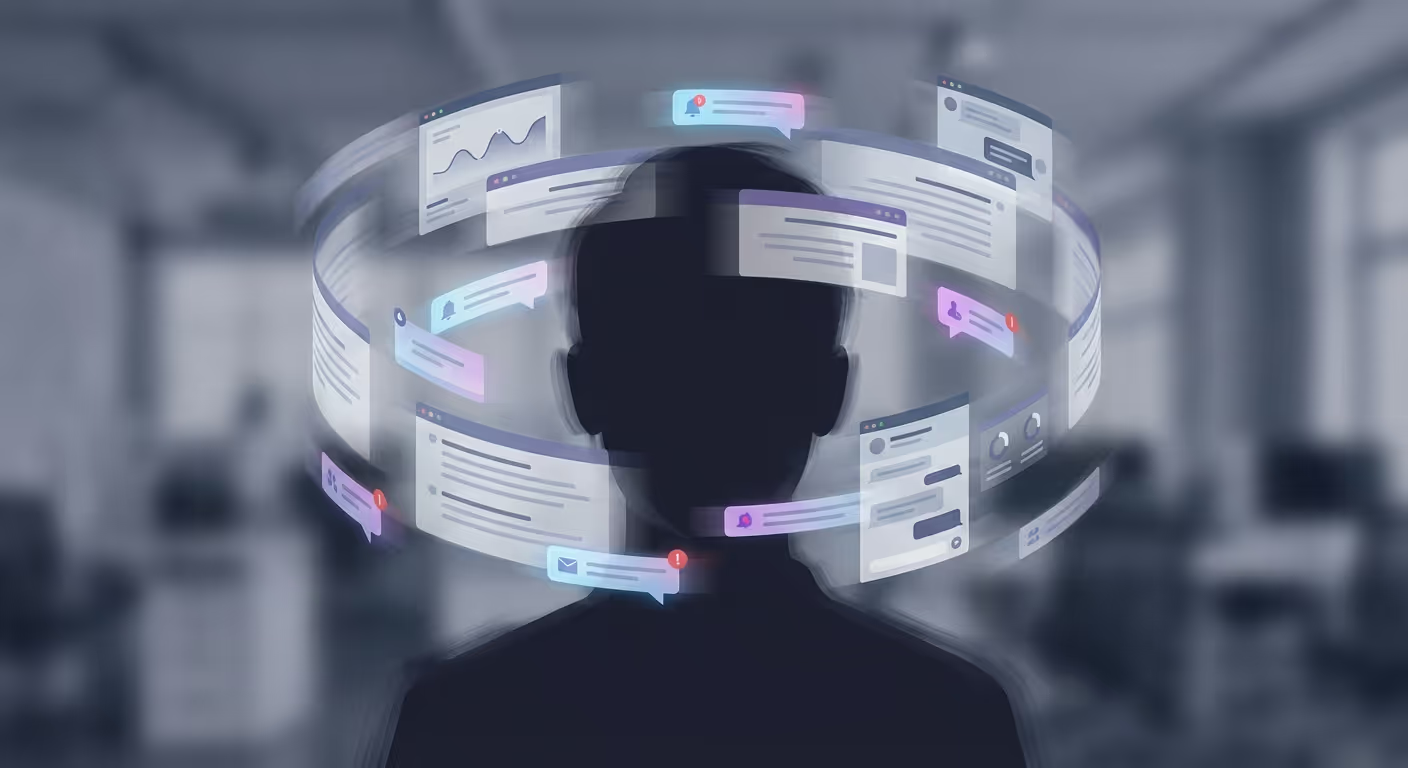

The Hidden Cost of Context Switching
How many times have you sat down to focus on something important, only to be pulled away within minutes? A Teams notification. An email that 'just needs a quick reply.' A colleague with a question. A meeting that appears on your calendar.
Each interruption feels small. A few seconds here, a minute there. But the research tells a different story: those small interruptions are costing you, and your organisation, far more than you realise.
What Context Switching Actually Costs
Context switching is the act of shifting your attention from one task to another. It's not the same as taking a break. It's being pulled away from focused work to deal with something else, then trying to pick up where you left off.
The problem is that your brain doesn't switch instantly. When you move from writing a report to answering an email to joining a meeting to reviewing a spreadsheet, your brain has to reload the context for each task. That takes time and mental energy.
How much time? Research from the University of California, Irvine found that it takes an average of 23 minutes and 15 seconds to fully refocus after an interruption. And workers in their study spent just 11 minutes on a task before switching to something else, meaning most people never reach full focus in the first place.
Other research paints a similar picture. Studies have found that frequent context switching can consume up to 40% of productive time. Atlassian estimates that context switching costs the global economy approximately $450 billion annually.
Those aren't abstract numbers. They're real hours, real output, and real money, disappearing into the gaps between tasks.
Why It Feels Normal (But Isn't)
The challenge is that context switching has become the default mode of work. Notifications are constant. Meetings fill calendars. Tools multiply. The expectation of rapid response is baked into workplace culture.
Microsoft's own research found that employees are interrupted every 2 minutes during core work hours, an average of 275 interruptions per day when you include activity outside the 9-to-5. Sixty percent of meetings are unscheduled. Chats outside work hours are up 15% year-on-year.
In this environment, focused work isn't the norm. It's the exception. And because everyone else is operating the same way, it feels like this is just how work is.
But just because it's common doesn't mean it's effective. The research is clear: constant task-switching makes us less productive, not more.
The Hidden Effects
The cost of context switching goes beyond lost time. Studies have found that frequent multitasking is associated with:
Reduced work quality: When attention is fragmented, mistakes increase. One study of software engineers found that context switching led to measurably more bugs in code.
Mental exhaustion: Research from the University of California, Irvine found significantly heightened stress, frustration, and perceived workload after just 20 minutes of repeated interruptions. Your brain isn't designed for constant switching; when you force it, fatigue accumulates.
Impaired memory: Working memory, your ability to hold and process information, declines with frequent multitasking. Some studies have found measurable reductions in gray matter in brain regions associated with attention among heavy multitaskers.
Shorter attention spans: The more you context switch, the harder it becomes to sustain focus. It's a vicious cycle: interruptions train your brain to expect interruptions.
None of this shows up on a timesheet. But it shows up in the quality of thinking, the pace of progress, and how people feel at the end of the day.
Why We Keep Doing It
If context switching is so costly, why do we keep doing it?
Part of it is structural: open-plan offices, always-on communication tools, and meeting-heavy cultures create an environment where interruptions are inevitable.
Part of it is cultural: responsiveness is rewarded. The person who replies instantly looks engaged; the person who batches their emails looks slow. Even when we know that deep work produces better results, the incentives often push toward availability.
And part of it is psychological: interruptions often feel urgent, even when they're not. A notification creates a small dopamine hit. Responding makes us feel productive, even if we're not actually moving important work forward.
Research has found that workers are just as likely to interrupt themselves as to be interrupted by others. We've internalised the pattern.
What You Can Do About It
You can't eliminate context switching entirely. Some interruptions are genuinely urgent, and collaboration requires communication. But you can reduce unnecessary switching and protect time for focused work.
1. Protect focus time
Block time in your calendar for focused work. Treat it like a meeting, non-negotiable unless something genuinely urgent comes up. Even one or two hours of protected time per day can make a meaningful difference.
Research suggests that people are most focused when they work for around 50-60 minutes followed by a short break. The Pomodoro Technique (25-minute focused blocks with 5-minute breaks) is another popular approach. Experiment to find what works for you.
2. Batch similar tasks
Instead of checking email every time a notification pops up, check it at set times. Instead of responding to messages throughout the day, batch your responses. Grouping similar tasks reduces the mental overhead of switching between different types of work.
3. Turn off notifications
Most notifications aren't urgent. Turning off non-essential notifications, or using focus modes that suppress them during work blocks, removes the trigger for many unnecessary switches.
This doesn't mean being unresponsive. It means being intentional about when you check messages rather than reacting to every ping.
4. Set expectations with colleagues
If your team expects instant responses to every message, that expectation creates constant interruptions. Have explicit conversations about response times. For most things, an hour or two is fine. For genuinely urgent matters, you can agree on a different channel (phone call, urgent tag, etc.).
5. Review your tools
The average knowledge worker uses multiple apps and toggles between them constantly. Ask yourself: do you actually need all these tools? Are there opportunities to consolidate? Every tool you add is another potential source of interruption. This is one of the reasons Microsoft 365 training delivers real productivity gains. When teams understand how to use the tools they already have effectively, they stop switching between alternatives.
What Organisations Can Do
Individual tactics help, but culture change requires organisational commitment. Leaders can:
- Model focus time: When leaders protect their own focus time and respect others', it signals that deep work is valued.
- Rethink meeting culture: Every meeting is an interruption for someone. Default to shorter meetings. Question whether meetings are necessary. Leave gaps between back-to-back sessions.
- Set communication norms: Establish expectations about response times, urgent vs. non-urgent channels, and when it's okay to go heads-down.
- Measure what matters: If you only measure responsiveness and output volume, you incentivise context switching. If you measure outcomes and quality, you incentivise focus.
The Bottom Line
Context switching isn't a minor inconvenience. It's a significant drag on productivity, quality, and wellbeing. The research consistently shows that fragmented attention leads to worse outcomes than focused work.
The good news is that small changes can make a real difference. Protecting even a few hours of focus time per week, batching communications, and reducing unnecessary interruptions can reclaim hours of productive time.
In an environment that constantly pulls us in different directions, the ability to focus has become a competitive advantage. The individuals and organisations that learn to protect it will outperform those that don't.
At IQIT, we help organisations work smarter through Microsoft 365 training and AI adoption that reduces the switching and manual work dragging your team down. Get in touch to explore how we can help.



Ready to get more from Microsoft 365?
Book a free consultation to talk through where you are and where you want to be. No pressure, no hard sell. Just an honest conversation.