
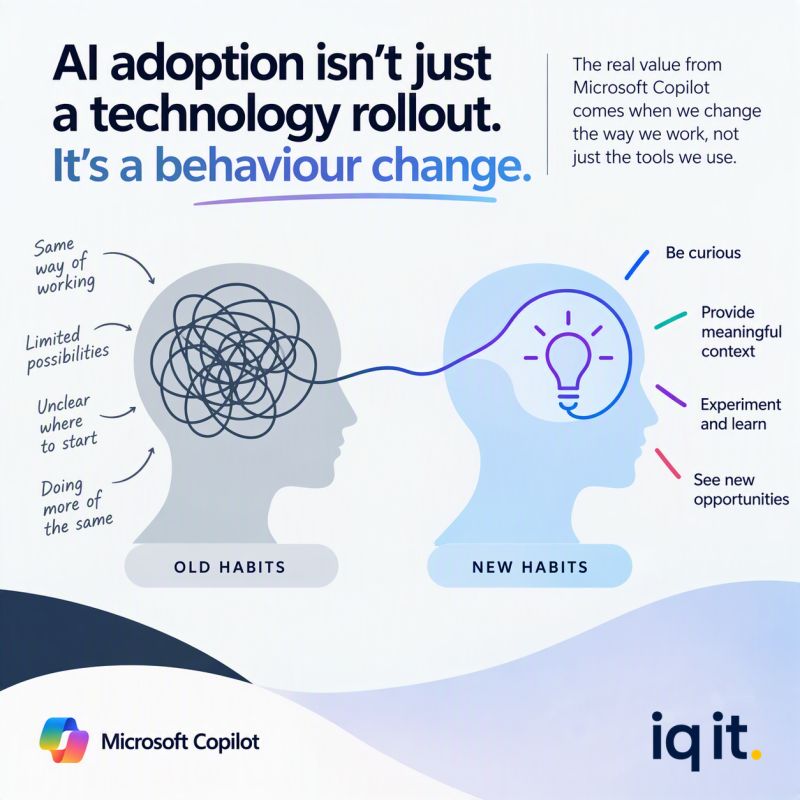

We've delivered Microsoft Copilot training to staff across accountancy, legal services, transport, retail and investment management, from small teams to businesses with more than 1,000 employees. The pattern is the same everywhere. Very few people struggle with Copilot itself. The real challenge is learning a new way of working, and that is a people problem before it is a technology one.
Key takeaways
- Most Copilot problems aren't technical. They're habits: involving AI in a task, giving it context and reviewing a draft instead of writing from scratch.
- The biggest barrier is recognition, not willingness. People don't yet have an instinct that says "this is a job for Copilot".
- EY's 2025 Work Reimagined Survey found 88% of employees use AI at work, but only 5% use it in ways that change how they work and only 12% feel they get enough training.
- A room always contains people who have never opened Copilot and people who use it daily. Training has to work for both.
- Lasting adoption needs four things from training and support: knowledge, awareness, confidence and encouragement.
- Treat it as a behavioural change programme with discovery, champions and follow-up, not a software rollout.
The real challenge is a new way of working
When a Copilot rollout stalls, it's rarely because people couldn't find the button. It's because using AI well asks them to change how they approach ordinary work. In every session we run, people are learning to:
- Involve AI in a task at all. Remembering Copilot exists at the moment it could help, rather than an hour after the job is done.
- Converse rather than command. Treating it as a back-and-forth, asking follow-up questions and refining, instead of typing one line and judging the first result.
- Provide context rather than just search. Explaining who the output is for, what it's based on and what good looks like. A question typed like a search query gets an answer like a search result.
- Experiment and refine rather than expect perfection first time. The first response is a starting point. People who get value from Copilot iterate; people who give up on it judged it on one attempt.
- Create drafts to review rather than create everything from scratch. The shift from author to editor is the single biggest time saver, and the hardest habit to form.
None of those are software skills. They're working habits, and habits take longer to change than most rollout plans allow for. It's why train and leave doesn't work for AI.
Knowing when to use it
One of the biggest barriers we see isn't a lack of willingness. It's recognising what Copilot can actually be used for.
That's understandable. Using AI at work is a new human behaviour and we are the first adopters on this scale. There's no established habit to fall back on, no generation of colleagues who've done it before us and no instinct that tells us "this is a job for Copilot".
When we sit down to write a report, prepare for a meeting or work through a long email thread, we default to the way we've always done it. The opportunity to involve AI passes before we've noticed it was there.
That's also why so many people stall at the basics. They use Copilot for the handful of tasks they were shown in a session, usually summarising an email thread or tidying a paragraph, but they haven't yet learned to spot the dozens of other moments in a working day where it could help. We've written about the common Copilot mistakes that come from this, and most of them are habits rather than misunderstandings.
Access is not the problem
The numbers back this up. EY's 2025 Work Reimagined Survey, which covered 15,000 employees and 1,500 employers across 29 countries, found that 88% of employees now use AI at work. Most of that use is limited to basic tasks such as search and summarising. Only 5% use AI in advanced ways that transform how they work, and only 12% say they receive sufficient AI training to get the full benefit.
Read those three figures together and the picture is clear. Nearly everyone has the tool. Very few have the habits, and even fewer have had the help to build them. Access is not the problem. Recognition, confidence, habits and support are, and none of those come with the licence.
Every room has three audiences
The practical difficulty with Copilot training is that no two people in the room are starting from the same place. When we began working with Armstrong Watson, a 900-person accountancy firm, some staff had been experimenting with Copilot on their own initiative for months and others had never opened it. There was no shared baseline and no consistent approach. That mix is normal. In almost every session there are people who are sceptical, people who are curious but haven't started and a few who are already ahead of the material.
Every programme we run is bespoke, so we can split sessions by skill level when a client needs it. In practice we rarely do. Everyone in the room usually gets the same training, and the job is finding the balance: enough grounding that the person who has never opened Copilot keeps up, enough depth that the person who uses it daily still leaves with something new. A few things make that work:
- Discovery before content. We don't start with a deck. We start with a session with the people who know how the organisation works, to understand how information is created, managed and shared, what the AI policy says and which tasks fill people's weeks. At Armstrong Watson that was a two-hour discovery with the Chief Executive, IT leadership and L&D before any training was written. At Beever and Struthers it was regular discovery sessions looking at the firm's existing files and habits. Our advisory and discovery work exists for exactly this reason.
- Pilot with a small senior group first. Before the Armstrong Watson rollout, seven senior and technical users tested the content hands-on and their feedback reshaped it. The wider firm then got a tested programme rather than a generic one.
- Small, hands-on groups. We recommend groups of up to 12 and never more than 15, for two hours, with everyone's Copilot open. One to one is ideal and smaller is always better, but 12 is the practical ceiling for a session that stays hands-on. It keeps things conversational, lets the confident people share what they've found and gives the hesitant people room to ask the question they wouldn't ask in a room of fifty. The 84 sessions we ran at Armstrong Watson over six weeks were capped at around ten for exactly that reason.
- Scenarios from their own work, not demos. Prompts built around the organisation's real documents, email threads and reports. Someone who has just watched Copilot summarise a client thread like the ones in their own inbox sees the point immediately. For Charles Tyrwhitt that meant exercises in the Microsoft 365 apps staff already used, aligned to the retailer's own AI policies.
- Materials people can go back to. A branded training guide, recordings of every session and, at Armstrong Watson, daily prompt emails after training to build the habit. The beginners use these to catch up. The advanced users use them to go further.
Where grouping by level does earn its place is the underlying applications. For Charles Tyrwhitt's Excel programme we assessed skill levels first and grouped staff accordingly, so nobody sat through basics they knew or content they weren't ready for. People who are comfortable in Excel, Word and Outlook get far more from Copilot in those apps, which is why Microsoft 365 training is often the right first step rather than an afterthought.
What staff actually need
Strip all of that back and every effective adoption programme gives staff four things:
- Knowledge. Practical skills they can apply to their own work straight away, taught in the apps they already use. That is what our Copilot training is built around, starting with Copilot Essentials for every member of staff regardless of licence.
- Awareness. The ability to recognise where Copilot fits into their day and where it adds real value, so the moments stop passing them by. This is the gap that separates the 88% from the 5%.
- Confidence. Reassurance that it is safe to use, that it only sees what they already have permission to see, that their organisation's AI policy supports them and that their professional judgement still matters.
- Encouragement. Permission to experiment, make mistakes and keep going. In a regulated firm that permission has to come from the top and be said out loud.
Most rollouts deliver the first. The other three are what separate a licence that gets used from one that sits on the shelf.
Adoption is a programme, not an event
Skills and confidence don't arrive in a single session. They grow through regular training and support, as people's confidence increases and as Copilot itself evolves. What it could do six months ago is not what it can do today, and a one-off course can't keep pace with that.
That's why our Copilot Adoption Programme runs in four stages rather than one: diagnostic and alignment, foundational training, targeted adoption for specific teams and roles, and embedding. The first two happen once across the organisation. The last two keep going, team by team.
The embedding stage is the one most organisations skip, and it's where the behaviour change actually sticks. At Armstrong Watson that meant an AI Adoption Framework with a senior adoption group, departmental groups supported by champions and clear criteria for who gets Copilot Premium and why. Since the rollout the firm has been running Copilot Fridays and office-led sessions where staff share real use cases, and a selective Premium rollout is being guided by evaluation data and usage analytics rather than guesswork. We've covered what that structure looks like in Copilot adoption needs more than training.
The results from that programme show what happens when the people side is taken seriously. Across 109 evaluation responses, 97% said the training improved their understanding of Copilot and AI, 99% intended to experiment with it and 95% felt able to apply what they'd learned to their day-to-day work.
The honest summary
AI adoption isn't primarily a software implementation. It's a behavioural change programme. The licence gets everyone to the starting line. Whether they get any further depends on recognition, confidence, habits and the support to build them.
Technology is only one part of the equation. People are the rest of it.
At IQIT we help UK organisations get real value from Copilot, from hands-on training built around your own work to a full adoption programme with discovery, champions and follow-up. If your team has the licences but not the habits, book a free consultation or get in touch.

Ready to move from Copilot access to Copilot adoption?
Book a free consultation to talk through where your organisation is with Copilot and what the right next step looks like. No pressure, no hard sell. Just an honest conversation.

